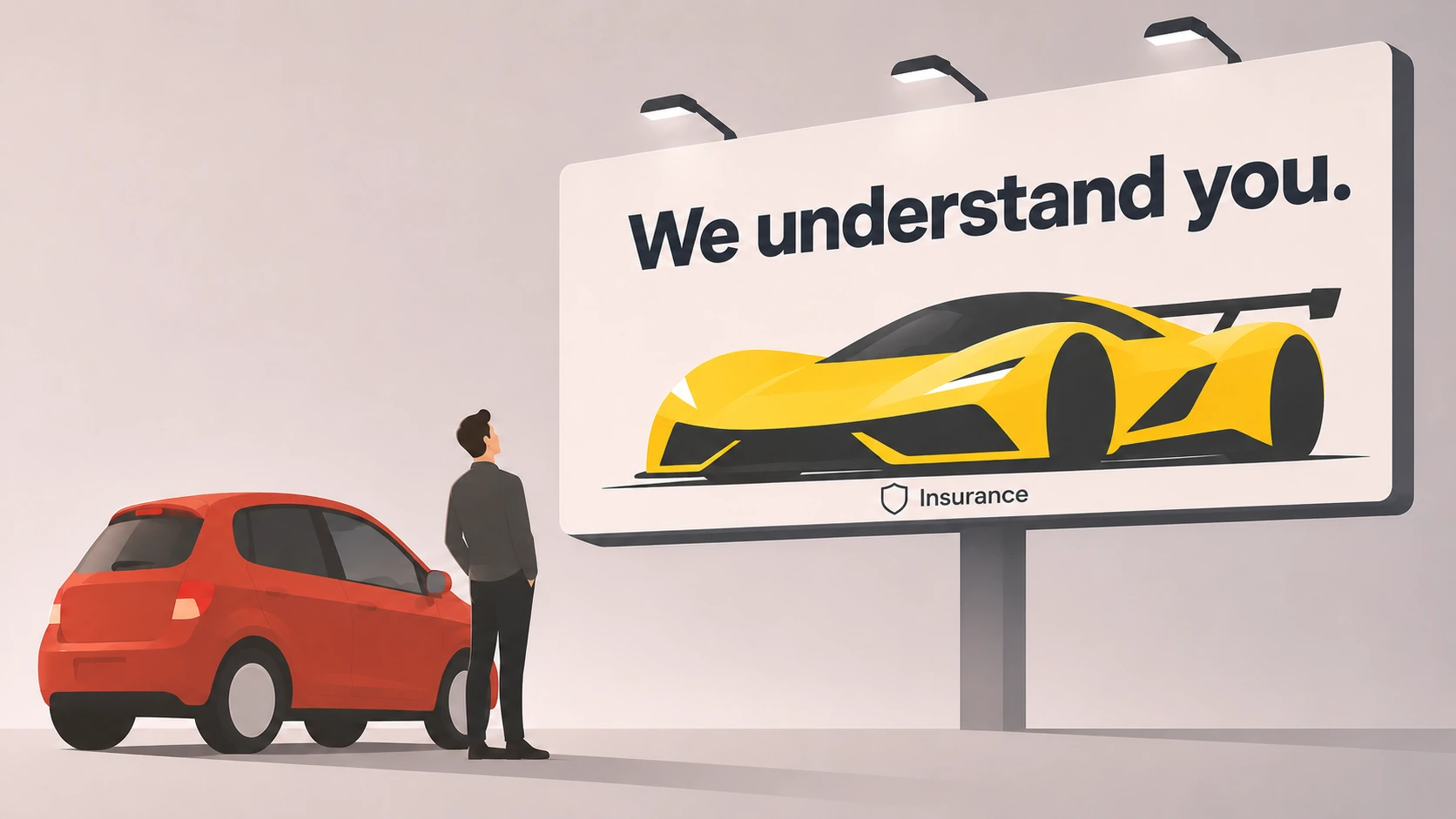
There’s a small detail in the illustration above that explains why. A man has parked his red hatchback beneath an insurance billboard. Above him is a yellow supercar and the line “We understand you.” It’s a perfectly plausible ad. The art director has chosen a car that will catch your eye, and with one poster to show everyone who drives past, that choice makes sense. What interests me is what happens when the man gets home, opens the insurer’s website and finds the same yellow supercar waiting for him.
A website has an advantage that a billboard will never have. It can ask the man what he drives and give him a moment to answer. Yet even with AI available to help us build almost anything we can imagine, a website brief still tends to produce a homepage, a navigation menu, a hero image and a series of pages the visitor has to work their way through. We can produce all of that much faster now. I’m more interested in what we might build if the sitemap came a little later in the conversation.
What would you like to know about your car insurance?
Imagine you’re thinking of replacing that red hatchback with an electric car. You’ve spent an evening with the configurator, chosen the metallic blue finish and gone back twice to look at the wheels. Now you want to know what it would cost to insure. On a familiar insurance website, you might enter the model and year, get a price and scroll down a table explaining the different levels of cover. By the time you reach the bottom, you know which option costs more. You might still be a little unsure what the extra money buys you.
I’d like to see what happens if we give the same information to an art director and a good insurance adviser. They could show you the blue car you’ve been considering, parked on a street in Copenhagen. While you’re away, another driver clips the front wing. What’s the first thing you do when you get back? Who arranges the repair, and what will you have to pay yourself? A short sequence could take you through those decisions using the terms of the policy you’re looking at. Change the cover and you could replay the part where the outcome changes. Now you have something to weigh against the difference in price.
Perhaps a parking accident is the least of your concerns. Every summer you drive abroad with your family, and what you really want to know is whether anyone will help if the car breaks down halfway through the holiday. You could ask that question in your own words and carry on from there. The insurer already knows which car and policy you’re considering because you’ve just told it. There’s no reason to make you find the roadside assistance page and start the conversation again.
The blue paint and the wheels help you recognise the car. They also give the art director a way into a subject most of us have very little interest in until we need it. But if the film shows a replacement car arriving when the policy only covers a tow, the insurer has just made a promise it can’t keep. I’d want the person responsible for the policy wording involved in that creative discussion from the beginning. A single scene that explains an exclusion clearly would be worth more to a prospective customer than a beautifully produced film that leaves it open to interpretation.
From a target audience to the person choosing the policy
In advertising, we’ve become quite good at describing the people we think we’re talking to. A brief might identify families considering their first electric car, and the team will make dozens of decisions on their behalf. Which family should we cast? Where do they live? What sort of journey would feel familiar? Eventually someone has to choose, because the photographer needs a location and the campaign needs a picture. Those are sensible production decisions. They also mean that a lot of assumptions about the audience end up in the finished work.
This is where I see a role for hyper-targeted communication. Two people can be looking at the same model, the same price and the same insurance policy for entirely different reasons. One parks on the street in Copenhagen and worries about damage while the car is unattended. The other has a garage and is mostly interested in getting the family home from a holiday. Either of them could tell you that in a sentence. Once they have, the next image you show and the explanation you give can reflect what they’ve actually asked.
I would happily tell an insurer where I usually park if it helps explain my cover. I’d be much less comfortable with a website announcing that it already knows where I leave my car at night. There’s a creative decision in how you ask for information, how much you ask for and what the visitor gets in return. In this case, one question does the job. Someone who just wants the policy document should be able to open it and get on with their day.
What does the content team publish?
For years, the content management system has given marketing teams a fairly straightforward job. Write the pages, choose the pictures, check the links and approve what the visitor will see. A real-time experience changes what needs approval. The insurer can sign off its policy wording, pricing rules and claims process in advance. Its creative team can agree on how a car is shown, which situations are appropriate to illustrate and what the brand should sound like when somebody has just had an accident. The customer’s question then determines which of those things come together on screen.
Take that damaged front wing. The creative team can decide how to stage the scene and where to stop it so the customer can compare two policies. The claims team can establish exactly which differences the comparison should show. If the insurer later changes who arranges the repair, that approved information needs to carry through to every version of the scene. That’s a more interesting discussion to have with a CMS supplier than how many landing-page templates come with the platform. It also gives the brand a good reason to keep an ordinary, dated policy document within easy reach.
There’s no particular reason this should be limited to insurance. Consider a manufacturer selling the same piece of industrial equipment to three people at one company. The technical specialist wants to know whether it will fit on the existing line. The procurement director needs to understand running costs. The CEO is interested in whether the investment makes sense at all. A dimensioned drawing might settle the first question in seconds. An interactive cost calculation could help the second person prepare a recommendation that the third can take to a board meeting. The manufacturer already has much of that material. The opportunity is to bring the right part forward when somebody asks for it.
As Scenes sees it
When anyone can generate a polished homepage, I suspect the most revealing part of a website pitch will be the brief. I’d like to hear a team explain which customer decision they want to help with, what makes that decision difficult today and why the experience they propose would make it easier. That gives the creative work something concrete to aim for. In the insurance example, I’d judge the result by whether the driver can explain what happens to his car after an accident and why he chose one policy over the other.
At Scenes Lab, one part of that question already shapes our work on Smart Images. The art director decides which details make an image recognisably the brand’s and which can respond to the situation in which it’s seen. I think the same question belongs in the brief for the wider website. We used to build websites and invite people in. Tomorrow, we may build the experience around the person who arrives. If you’re working on a brief where that would make a difference, I’d love to hear about it at Scenes Lab.